
Frequently Asked Questions
Straight answers about automation, tube forming equipment, and service, with links to the detail where you want more.
If your question is not here, ask it and we will answer it directly.
About Integrion Automation
What does Integrion Automation do?
We design, build, and program automated production systems, and we manufacture tube forming equipment under the Wauseon TubeTech brand. Robotic automation, tube end forming and finishing machines, and field service for both. Everything is engineered and built in Wauseon, Ohio, including the machining, the controls, and the programming.
Is Integrion Automation the same company as Wauseon Machine?
Yes. Integrion Automation is the company formerly known as Wauseon Machine. The name changed, the ownership, the engineering team, the equipment, and the parts library did not. If you bought a machine from Wauseon Machine, it is still supported by the same people.
How long has Integrion been in business?
Since 1983. More than 40 years of designing and building automation and tube forming equipment, with 450 or more robotic integrations and over 1,000 automation systems installed. Not every automation system involves a robot, which is why those two numbers are different.
Are you a robot manufacturer or an integrator?
An integrator. We do not build robots. We design the cell around them, build the tooling and fixtures, write the programming, wire the controls, and support the system afterward. That means we can specify the right robot for the application rather than the one we happen to make.
What industries do you serve?
Automotive, aerospace, HVAC, off road, life sciences, food and beverage, consumer products, electronics, energy, transportation, warehousing and fulfillment, and general industrial. The engineering problems change more by environment and documentation requirement than by industry label.
Where are you located and do you travel?
Wauseon, Ohio, between Toledo and Fort Wayne. Wauseon is our only location. Our field service engineers travel to customer facilities across the United States, and our equipment runs in plants around the world.
Automation and Robotics
How do I know whether my line is ready for automation?
The honest test is whether the process is stable. Consistent incoming parts, a repeatable sequence, and a known cycle are what automation amplifies. If those are missing, automation amplifies the inconsistency instead. Labor constraints, quality escapes, and changeover time are the usual triggers to look.
What is a turnkey automation cell?
A complete system delivered ready to run, where one supplier owns the design, the build, the tooling, the controls, the programming, the safety, and the runoff. The alternative is coordinating several vendors and owning the gaps between them yourself.
What kinds of automation applications do you build?
Assembly, machine tending, pick and place, part feeding, part joining, palletizing, precision cutting, inspection and testing, web handling, and data and traceability. Most systems combine several of those rather than doing one thing.
Can you automate palletizing?
Yes, including with collaborative robots where floor space and safety fencing are constraints. Palletizing is one of the most common first automation projects because the task is repetitive, the payback is easy to see on the floor, and it removes a physically hard job.
Can a robot load and unload our machine tools?
Yes. Machine tending is one of our core applications, covering CNC machines, presses, and forming equipment. The engineering work is usually in the part presentation and the gripper rather than in the robot itself, which is where an integrator earns the fee.
Do we have to automate everything at once?
No, and it is usually a mistake to try. Scalable automation means building the first cell so the second one can attach to it, rather than committing all the capital in one project before you have production data. Start where the constraint actually is.
Can you handle inspection and quality data?
Yes. Vision inspection, gauging, leak and functional test, and the traceability layer that records which part passed which check and when. On regulated work the data trail is often the reason the cell exists in the first place.
Do you build UL 508A control panels?
Yes, and it is worth knowing what the mark actually certifies UL 508A applies to the industrial control panel as an assembly, covering component selection, short circuit current rating, wiring, and labeling. A panel built from listed components is not the same thing as a listed panel.
What does industrial automation actually look like in practice?
It ranges from a single robot tending one machine to a full line with feeding, joining, inspection, and palletizing tied together. The useful way to evaluate it is by the problem being solved rather than by the technology being installed.
How should we evaluate automation suppliers?
Ask who does the engineering, who writes the programming, who builds the panels, and who answers the phone in year six. Suppliers that subcontract those pieces are coordinating on your behalf, which is fine until something goes wrong and the accountability splits.
Do you have experience with regulated life sciences work?
Yes. Life sciences automation is less about the robot and more about documentation, validation, cleanability, and change control. If a supplier cannot describe how they handle those, the equipment will pass runoff and fail qualification.
Tube Forming Equipment
What is Wauseon TubeTech?
Wauseon TubeTech is our tube forming equipment brand, covering end forming and end finishing machines, tooling, retrofits, and full production support. The machines are designed and built here, and the forming tooling is developed and proven in house before it ships.
What tube forming machines do you build?
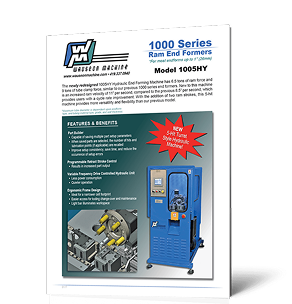
Ram endformers across five series covering tube from 3/8 inch to 3 inches, in pneumatic, hydraulic, and electric servo configurations, plus end finishing machines and hydraulic presses for crimping. Anything outside the standard range is handled as a custom build.
What is the difference between end forming and end finishing?
End forming shapes the tube end into a feature such as a bead, flare, swage, or quick connect. End finishing prepares the end, squaring it, trimming it to length, removing burrs and chips, and sizing it. A form is only as consistent as the end it starts from.
Do you make the forming tooling as well as the machine?
Yes, and it is the part that decides whether the form holds tolerance. We design the form progression, machine the tooling in house, and prove it out on a development machine with samples submitted for approval before it ships.
Can a tube forming machine be robot loaded?
Yes. Our machines are built automation ready, so forming and finishing can run in one cell rather than as two manual operations. Because we do the integration ourselves, a machine bought standalone can be automated later without being replaced.
Can I still get parts and service for an older Wauseon machine?
Yes. Critical spare parts, obsolete components produced to print, maintenance, and repair are all supported, including on machines built decades ago. In most cases the print and the build records are on file, so a parts request does not start from scratch.
Can you run parts for us instead of selling us a machine?
Yes. Finished parts supply covers emergency capacity, short run production, and long term supply, run on our equipment, on leased equipment, or on your own machine installed on our floor. It exists so a timing or capital problem does not stop your deliveries.
Service, Parts, and Upgrades
Do you service equipment you did not build?
Yes. A large share of the automation we support was integrated by somebody else, often by an integrator who is no longer involved. We also support cells running robots from more than one manufacturer, which is common in plants that automated in stages.
What does robot preventive maintenance include?
Mechanical and electrical inspection, grease and oil replacement, battery replacement, and controller checks, plus the equipment around the robot. Fixtures, feeders, safety circuits, and vision are usually where drift shows up first, so they are part of the same visit.
How do we get help when a line is down?
Call us or submit a service ticket and describe what the system is doing. Remote diagnostics and phone troubleshooting come first because they are faster, and a good share of faults turn out to be a program, a setting, or a sensor rather than a failed component.
Should we upgrade our existing equipment or replace it?
It depends on where the limitation is. Frames, structures, and mechanics often outlast their controls by years, so if the constraint is obsolete controls, software, or capability, a retrofit is usually the better answer. If the mechanical base is worn out, it is not.
What is a Master Service Agreement?
An agreement that sets the support terms once so the next service call is a phone call rather than a procurement exercise. It is customizable rather than a fixed package, and it exists so the relationship is defined before a line is down.
Working With Us
How does a project start?
With a conversation about the part and the problem, not a quote. We review prints, volumes, and the current process, then recommend an approach. On automation projects a facility visit is usually part of that, because the constraint is often something you stopped noticing.
Will you come to our facility?
Yes, and for most projects we ask to. An on-site look at the process, the environment, and the material flow answers questions that prints do not. It is also the fastest way for us to tell you honestly whether we are the right fit.
What robot brands and technology partners do you work with?
We are platform independent and work across major robot brands and component suppliers, selecting for the application rather than for a single relationship. Our current partner and certification list is published rather than described in general terms.
Still Have a Question?
Ask it. A short conversation with an engineer answers more than a page like this can, and we would rather tell you we are not the right fit than sell you something that does not solve the problem. No pressure and no obligation. It is how we get you from complexity to confidence.
