Skip to content

    Robotic Palletizing

     End-of-line palletizing and Pick-Pack-Pal systems that keep product moving and take the heavy lifting off your team, backed by full lifecycle support. 

    What is Robotic Palletizing?

    Robotic palletizing is the use of industrial or collaborative robots to automatically stack finished products, cases, bags, or containers onto pallets. It replaces repetitive, heavy manual lifting at the end of the line with consistent, high-throughput, and stable pallet builds.

    At Integrion, we design palletizing systems around your products, pack patterns, and line speeds. Whether you need a single compact cell or a fully integrated Pick-Pack-Pal system that picks, packs, and palletizes in one flow, we help you match the right solution to your throughput and footprint.

    Our Robotic Palletizing Capabilities

    Robotic Case Palletizing

    Stacking cases, cartons, and trays into consistent, stable pallet patterns.

    Bag & Sack Palletizing

    Handling bagged and sacked products with tooling built for shifting, unstable loads.

    Depalletizing

    Automated unstacking to feed downstream lines without manual lifting.

    Mixed-Load & Multi-SKU Palletizing

    Building mixed pallets for distribution, retail, and e-commerce orders.

    Pick-Pack-Pal Cells

    Picking, packing, and palletizing combined into one integrated end-of-line system.

    Pallet & Slip-Sheet Handling

    Automated pallet dispensing, slip-sheet placement, and finished-load transfer.

    From Collaborative Palletizers to High-Speed Robotic Lines

    The right palletizing system depends on your throughput, product mix, and available floor space. We build across the full range:

    Collaborative (cobot) palletizers work safely alongside your team and fit tight spaces, ideal for lower or variable throughput.

    Single-robot cells handle one or two lines at moderate to high speed with a compact footprint.

    High-speed, multi-line systems consolidate several lines into one automated end-of-line operation for maximum throughput.

    If you are not sure which fits your operation, that is exactly the kind of conversation we like to have.
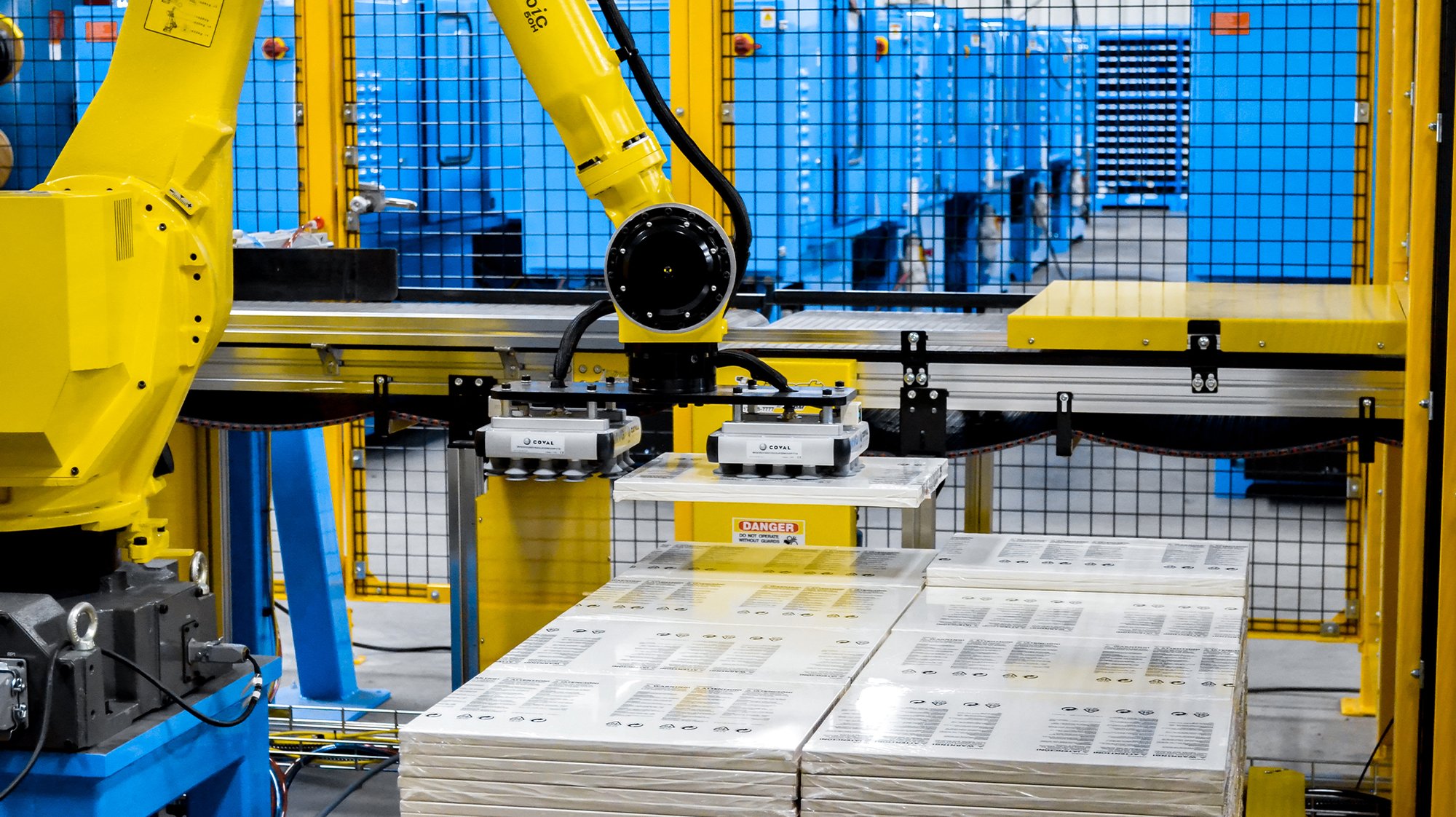
    Palletizers to High-Speed Robotic Lines

    Why Choose Integrion for Robotic Palletizing?

    For more than 40 years, manufacturers have trusted Integrion to design, build, and program automation in-house. That vertical integration means single-source accountability, fewer handoffs, and on-time delivery.

    We do more than build systems. We help you plan an automation roadmap, manage risk throughout the project, and support your equipment long after launch with a dedicated field service team. From complexity to confidence, we stay with you across the entire life of your system.

    person-with-hard-hat

    40+ Years of Experience

    star

    450+ Robotic Integrations

    tube forming tech svg

    In-House Design, Build and Integration

    throughput

    Full Lifecycle Support

    light-bulb

    Partnership Driven Approach

    stock-graph

    Certified and Proven

    Our Automation Process 

    Every palletizing project follows a proven path built to reduce risk and keep your timeline on track. Because we design, build, and program in-house, you get one accountable team from first conversation to long-term support. It is how we move your project from complexity to confidence.

    Robotic Palletizing Automation Process
    Step 1: Consult & Assess
    We learn your parts, volumes, and goals
    Step 2: Concept & Design
    We engineer a solution and show you the options and payback 
    Step 3: Build & Integrate
    We fabricate, assemble, and program your system in-house. 
    Step 4: Validate & Commission
    We prove out performance before it reaches your floor. 
    Step 5: Support & Sustain
    We keep your line running with service, spare parts, and support. 

    Frequently asked questions

    What is robotic palletizing?

    Robotic palletizing uses industrial or collaborative robots to automatically stack products, cases, bags, or containers onto pallets. It removes repetitive heavy lifting at the end of the line and produces consistent, stable pallet builds at higher throughput.

    What is Pick-Pack-Pal?

    Pick-Pack-Pal is our approach to end-of-line automation that combines picking, packing, and palletizing into one connected system. Instead of separate stations, product flows through a single integrated cell, which saves floor space and labor.

    What is the difference between palletizing and depalletizing?

    Palletizing stacks finished products onto a pallet for shipping or storage. Depalletizing does the reverse, unstacking incoming pallets to feed products into a production or packaging line. We build systems for both.

    Can a robotic palletizer handle mixed loads or multiple SKUs?

    Yes. With the right tooling and vision, a robotic system can build mixed pallets across multiple products and pack patterns, which is common in distribution and e-commerce fulfillment.

    What products can a robotic palletizer handle?

    Robotic palletizers handle a wide range, including cases, cartons, trays, bags, sacks, pails, and bundles. The end-of-arm tooling is matched to your specific product and pack pattern.

    What drives the cost of a robotic palletizing system?

    Cost depends on throughput, the number of lines and SKUs, product type, pack pattern complexity, and whether you need depalletizing or full Pick-Pack-Pal integration. We scope each project to your goals so you can compare options and payback before committing.

    Do you provide service and support after installation?

    Yes. Our dedicated field service team offers preventive maintenance, troubleshooting, retrofits, spare parts, and warranty support to protect uptime across the full life of your system.

    Let's Talk Through Your Palletizing Project!

    A short conversation is the easiest way to figure out the right approach, with no pressure and no obligation. Tell us what you are running at the end of your line and we will help you find the path from complexity to confidence.