Tube diameter.
This is the first filter and it eliminates most of the list immediately. Our standard range runs from 3/8 inch to 3 inches in outside diameter.
Endformers, end finishers, and benders for tube from 3/8 inch to 3 inches, and the robotic automation to run any of them. Every specification below on one page, so you can narrow the field before you talk to anyone.
Four things determine which machine fits, and they narrow the field fast. Have these ready and the conversation gets much shorter.
This is the first filter and it eliminates most of the list immediately. Our standard range runs from 3/8 inch to 3 inches in outside diameter.
Steel, stainless, copper, and brass all move differently under the same tool. Wall thickness drives how much force the form needs and how many hits it takes.
A single bead and a combination quick connect are not the same job. More complex forms need more ram hits, which points you toward a larger series even when the diameter would not.
Cycle rates across the range run from about 1.5 seconds to 22 seconds. Your takt time decides whether you need a servo electric machine, a hydraulic one, or a cell.
Sorted by maximum tube diameter. Every machine is designed for quick changeover and minimal downtime, and built to be robot loaded, so one bought as a standalone can be integrated into a cell later without replacing it. All of it is CE certified for sale into the European Economic Area.
Endformers
| Series | Max tube OD | Ram force | Tube clamp force | Ram hits | Cycle rate | Models |
|---|---|---|---|---|---|---|
| 1200 Series | 3/8 in | 3 ton | 6 ton | 2 | 1.5 to 2.8 sec | 1202 |
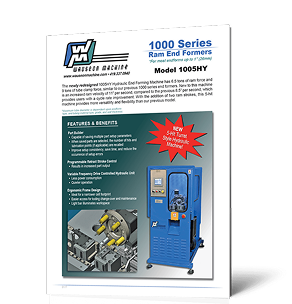
| 1000 Series | 1 in | 7 ton servo | 9 ton | 4 | 1.7 to 4.3 sec | 1004EL |
| 1100 Series | 1-1/4 in | 10 ton | 12.5 ton | 3 or 4 | 3.7 to 14 sec | 1103, 1104 |
| 1300 Series | 2 in | 12.5 ton | 25 ton | 4 to 6 | 3.7 to 17.5 sec | 1385HY, 1386HY, 1384EL |
| 1600 Series | 3 in | 50 to 70 ton | 80 ton | 3 or 4 | 12 to 22 sec | 1603, 1604 |
End Finishers and De-Coat
| Series | Max tube OD | Tool close force | Clamp force | Cycle rate | Models |
|---|---|---|---|---|---|
| 21CS-EL De-Coat | 3/4 in | 1 ton | 2 ton pneumatic | 4 to 10 sec | 21CS-EL |
| 2100 Series | 3/4 in | 2 ton | 2.5 ton hydraulic or 5.5 ton electric servo | 4 to 15 sec | 21HY, 21EL |
| 2600 Series | 2 in | 6 ton | 8 ton hydraulic | 4 to 15 sec | 26HY |
Hydraulic Presses
| Series | Max crimp diameter | Crimp force | Cycle time | Models |
|---|---|---|---|---|
| 71 Series | 1.25 in | 20 ton | 2 to 6 sec | 71HY |
| 72 Series | 3.75 in | 30 ton | 2 to 6 sec | 72HY |
Note: Ram stroke, maximum clamp opening, working pressure, air requirements, and electrical service vary by model. Full model-level specifications are available on request.
Three operations, each with its own machines and its own page. Automation sits on top of all three and is covered below.
Shapes the tube end into a finished feature: beads, flares, swages, reductions, expansions, and combination endforms such as quick connects. Five series from 3/8 inch to 3 inches, in hydraulic and electric servo configurations. This is the core of what we build.
Squares, trims, and deburrs the tube end so the forming operation starts from a consistent condition. Rotary roll and cut finishers up to 2 inches, plus a de-coat machine for coated tube.
Forms the tube between the ends rather than at them, which is how the routing gets into the part. Running bending alongside end forming means the routing and the endforms are produced within one process, instead of a bent tube shipping out to have its ends finished somewhere else. That matters most when the tolerance stack between the bend and the endform is what decides whether the part assembles.
Every machine in the tables above is built to be loaded and unloaded by a robot. Pair one with automation and the operator stops feeding the machine and starts tending the cell, which is the difference between one part at a time and a station that runs the shift.
This is the single most common reason customers come to us. Finding and keeping people to run a manual forming station has gotten harder, and the answer is usually not a faster machine. It is taking the loading out of a person’s hands so the cycle is the same at the end of second shift as it was at the start of first.
Because we build the machine, the tooling, and the automation in house, the cell is one system from one supplier rather than a robot integrator negotiating with an equipment builder. It also means a machine you buy today as a standalone can be automated later without being replaced.
What automation changes:
The tables above cover the standard range, and most parts land inside it. When yours does not, whether that is an unusual diameter, a form that needs more stations than a standard machine carries, or a cycle time no catalog machine will hit, we design and build around the requirement.
This is also true when your part sits between two series. That situation usually comes down to the endform rather than the diameter, and it is worth a conversation before you size up and pay for force you will not use.
For more than 40 years, manufacturers have trusted us to design, build, and program tube forming equipment in house. That vertical integration means single-source accountability, fewer handoffs, and on-time delivery.
It also means the machine and the tooling that runs in it come from the same team, and that team is still here when you need a second tool or a retrofit. From complexity to confidence, we stay with you across the entire life of your equipment.


Step 1: Process Evaluation We review your prints, processes, and parts, establish the best process for the part, review it with you, and quote it.
Step 2: Design and Build We design the concept, review it with you, and design the tooling package around it.
Step 3: Development A dedicated development technician modifies the tooling to your specifications, with tooling runoff in house, a five-piece tryout with samples submitted for approval, and capability studies available on request.
Step 4: Build to Print Parts produced to your print, with machining handled inside our own group, delivered ready to run.
Step 5: Production Support Uptime recommendations, downtime support, tooling troubleshooting, spare parts and tooling, machine maintenance, and refurbishment and modernization.
Step 6: Finished Part Supply Short run production, overage runs, emergency capacity, and long term supply contracts.
Send us your tube diameter, your material, and the endform you need and we will tell you which series fits and whether a standard machine will do it. No pressure and no obligation. It is the fastest way from a spec table to a decision.
Our standard range runs from 3/8 inch to 3 inches in outside diameter, across ferrous, non-ferrous, and plastic tube. The 1200 Series covers the small end and the 1600 Series covers the top of the range. Anything outside that is handled as a custom build.
Start with tube diameter, which eliminates most of the range immediately. Then check the endform itself, because a complex form needs more ram hits and can push you into a larger series than diameter alone would suggest. Material, wall thickness, and required cycle time settle the rest.
Electric servo suits faster cycles and tighter repeatability. Hydraulic suits higher force work and the larger end of the diameter range. Several series are offered in both, so the machine can match the part rather than the reverse.
That usually comes down to the endform rather than the diameter. It is worth reviewing the part before sizing up, because the larger machine means paying for force you may not need. Send us the print and we will tell you which way it goes.
End forming shapes the tube end into a feature. End finishing squares, trims, and deburrs the end so the forming operation starts from a consistent condition. Most production processes need both, and they can run in the same cell.
Yes. Every machine is built to be loaded and unloaded by a robot, and we do the automation in house, so a machine bought as a standalone can be integrated into a cell later without being replaced.
Yes. Our tube fabricating equipment conforms with the health, safety, and environmental protection standards required for products sold in the European Economic Area, which covers the European Union, the European Free Trade Association, Turkey, and the United Kingdom.
Yes. Custom endformers and endfinishers are designed and built around your production needs, whether that is an unusual diameter, more forming stations than a standard machine carries, or a cycle time a catalog machine will not reach.
Yes, and we develop it in house. We have a dedicated tryout machine matching every model we build, so the tooling is proven on the same configuration that will run it in your plant.
It is one of the machines on this page with a robot loading and unloading it, built and programmed as a single system. The operator tends the cell rather than feeding the machine part by part, which holds cycle time steady across a full shift
LoremUsually yes. Every machine we build is automation ready, so robot loading can be added later without replacing the machine. We can also automate equipment built by other manufacturers.
Yes. Our field service team offers preventive and general maintenance, troubleshooting, repairs, retrofits, warranty support, and spare parts across the full life of your equipment.