Automation Solutions
People of Integrion
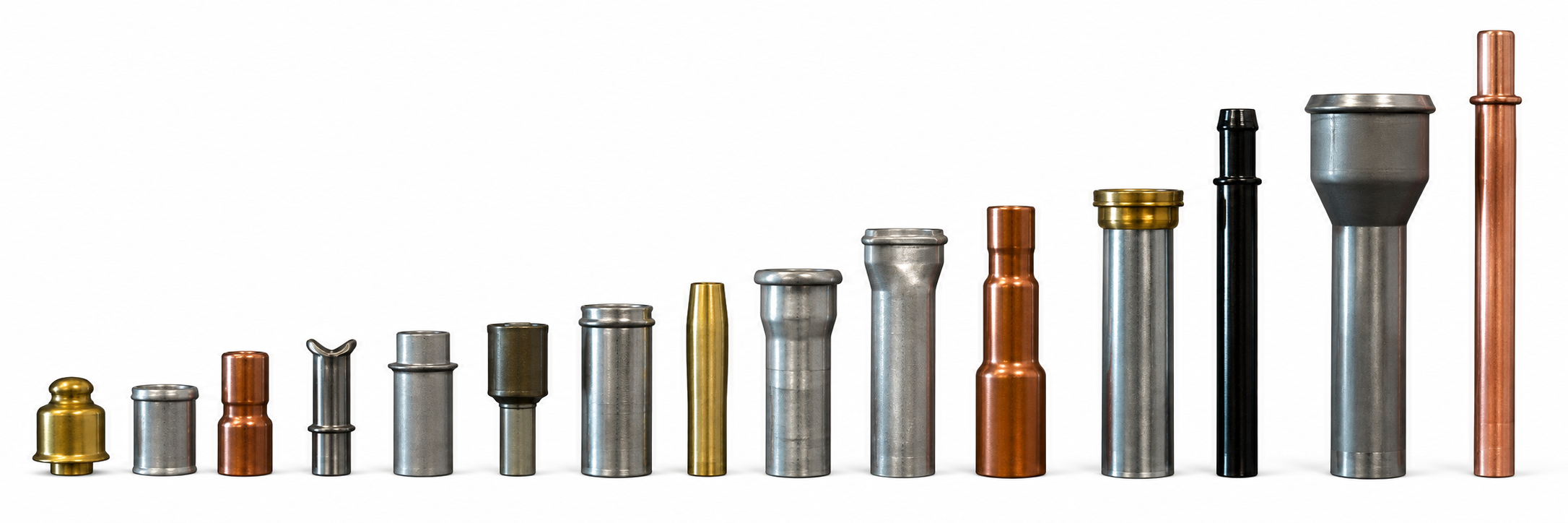

Choose a tube end form by what the end has to do. Beads retain hoses and set stops, swages slip into a mating part, expansions receive one, SAE forms match standard fittings, quick connect profiles lock into push-on couplings, and rotary finishing adds grooves, barbs or clean bare metal.
Most end form questions start with a print that already shows a shape. The harder question comes earlier: what does this end need to do once it leaves the machine? Answer that first and the form family usually picks itself. This guide walks through the six families Wauseon TubeTech forms and finishes, what each one is for, and what to check before you commit to tooling.
If you are still deciding which machine fits your tube size and volume, start with our tube end forming machines. This article stays focused on the form itself.
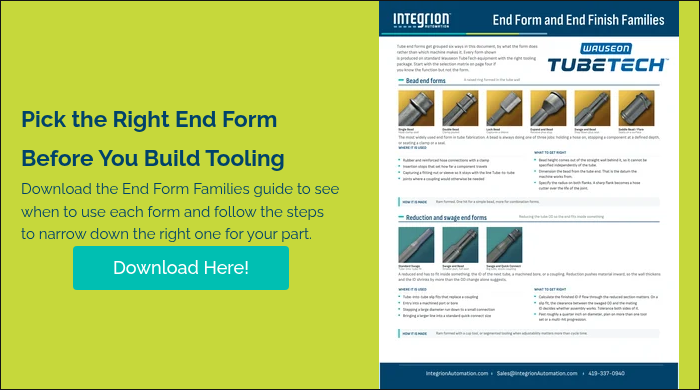
Tube end forms fall into six families, grouped by the job the end does in the assembly. The table below is the short version. Our one-page guide further down shows every profile side by side.
| If the tube end needs to... | Start with this family | Common profiles |
|---|---|---|
| Hold a hose or clamp, or stop insertion at a set depth | Bead end forms | Single bead, double bead, lock bead, saddle bead and flare |
| Fit inside a mating tube, bore or coupling | Reduction and swage | Standard swage, swage and bead, swage and quick connect profile |
| Snap into a push-on coupling | Quick connect | Quick connect profiles in 1/4, 5/16 and 3/8 inch |
| Mate with an off-the-shelf fitting to a published standard | SAE standard forms | Flare (SAE J533), O-ring face seal (SAE J1453), quick connect (SAE J2044), bead (SAE J1231) |
| Receive another tube or component inside it | Expansion end forms | Standard expansion, expand and bead, expand and flare, offset expansion |
| Carry a groove, barb or bare-metal surface | Rotary end finishing | Decoat, square groove, radius groove, barbs, bead and roll groove |
Use a bead when the end needs a raised ring that does mechanical work. A bead gives a hose something to grip under a clamp, gives an assembler a positive stop so the tube goes in to the same depth every time, and gives an O-ring or seal a shoulder to sit against.
A single bead covers most hose retention jobs. A double bead adds a second ring for more pull-off resistance or a captured seal between the two. A lock bead traps a nut, collar or bracket on the tube. Combined forms such as expand and bead or swage and bead put two features on one end so the tube can both locate and retain.
A swage reduces the tube end so it slips inside something. An expansion enlarges the tube end so something slips inside it. Both let you join two tubes or a tube and a component without a separate fitting, which removes a part and a potential leak point.
The choice usually comes down to which side of the joint the tube is on and how the joint is sealed. A swaged end pushed into a mating tube is common where the joint will be brazed or clamped. An expanded end that receives a mating tube suits slip joints and socket-style connections. An offset expansion moves the enlarged section off the tube centerline, which helps when the mating part does not sit on the same axis.
Use an SAE form when the tube has to mate with a standard fitting your customer or your service network can buy anywhere. Published geometry means the tooling is proven, the mating parts are off the shelf and a replacement line built years later will still fit.
If the part does not need to mate with a standard fitting, a custom form may be lighter, cheaper or easier to assemble. A standard form trades some of that freedom for interchangeability.
A quick connect end form puts a formed retention profile on the tube so it locks into a push-on coupling without tools. Assembly is fast, error-proof and easy to service. The profile has to hold tight tolerances, because the coupling depends on that geometry to retain the tube and seal. Our guide shows the 1/4, 5/16 and 3/8 inch profiles, and a swage and quick connect profile when the end also has to step down in diameter.
End forming moves the tube wall with a ram and tooling that push on the end. Rotary end finishing works the other way: the tool orbits the tube to roll a profile into the wall or remove a coating. It suits features that run around the circumference, such as grooves and barbs.
Many parts need both processes. A coated tube may be decoated, then beaded. Planning finishing and forming together keeps the end geometry consistent from one operation to the next.
Function narrows the family. These five checks settle the profile and the process:
A form that looks simple on a print can still be hard to run at volume. A form that looks complex may run cleanly with the right tool sequence. That is why we prove the tooling and the form together before a machine ships.
End forming uses a ram and tooling to push the tube end into a new shape, such as a bead, swage, flare or expansion. End finishing uses a rotating tool to roll grooves and barbs or remove coatings around the circumference. Many parts use both.
Yes. Multi-hit ram endformers run several tools in sequence on the same end, which is how combined forms such as swage and bead or expand and flare are made in one cycle. The number of hits a machine offers sets how complex a single end can be.
Use an SAE form when the tube must mate with standard fittings or couplings that are bought separately or replaced in the field. Use a custom form when the mating part is your own and a different geometry saves weight, cost or assembly time.
Yes. Material, wall thickness and temper set how far the end can be formed in one hit before it splits or wrinkles. Softer materials like copper form easily, while stainless and thin walls may need more hits or a different profile.
A print, a 3D model or a physical sample of the part. If you have the mating part, include it too. That is enough for an engineer to recommend a form family, a tool sequence and the machine that fits.
Send us a print, a 3D model or a sample and a Wauseon TubeTech engineer will review it at no cost. You will get a recommended end form, the tooling approach and the machine that fits your tube size and volume.