Automation Solutions
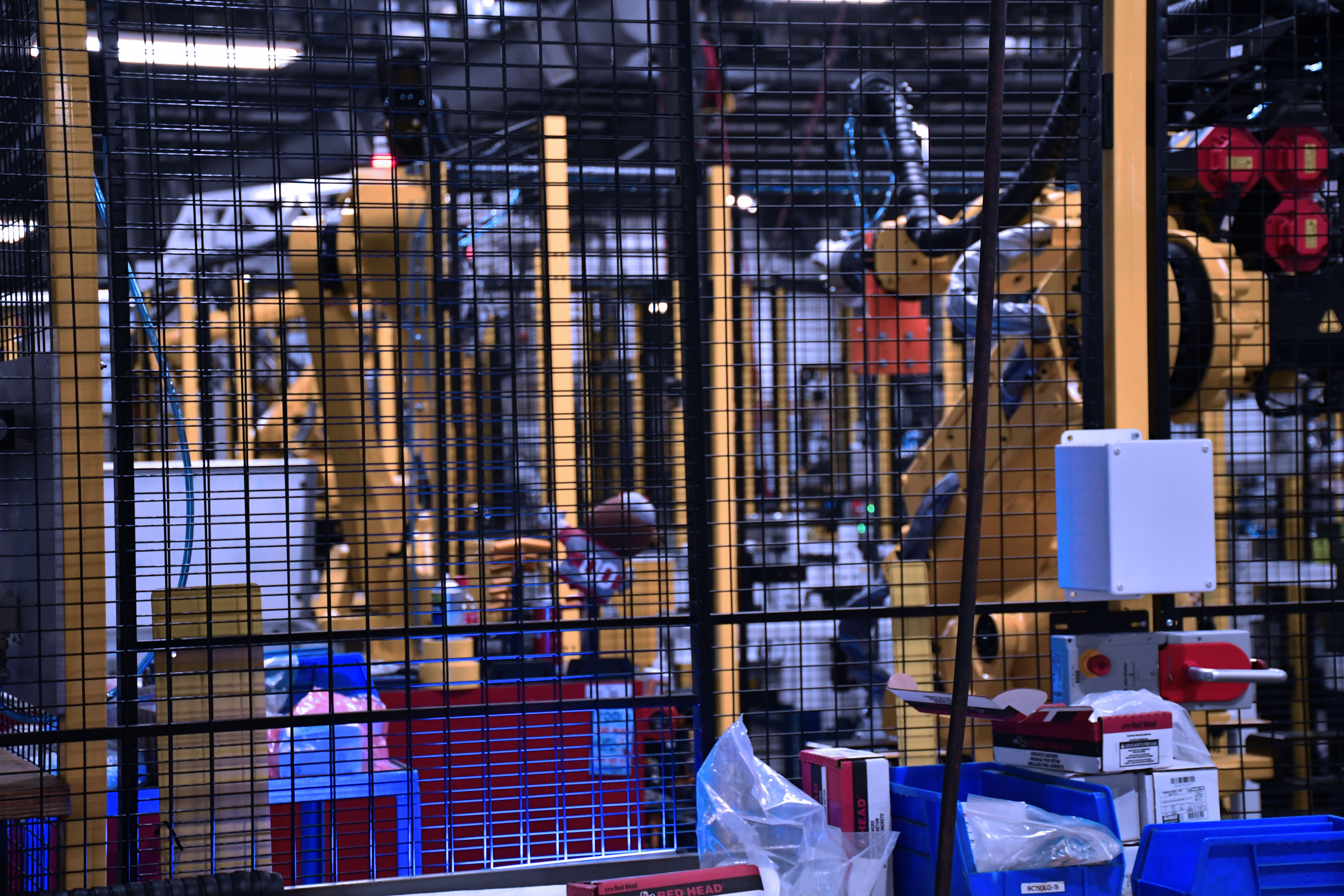

Manufacturers use robotics and automation for a defined set of tasks: moving material, tending machines, assembling parts, applying material, inspecting quality, and packing finished goods. The task decides the technology, not the other way around. Most first projects succeed because one repeatable task was scoped tightly instead of a whole line at once.
Most articles on this subject sort robots by type: articulated, SCARA, delta, cartesian, collaborative. That helps if you already know what you are building. It does not help if you are standing on your own floor trying to work out which of your processes is worth automating. 
So this one is organized by task instead. Find the operation that looks like yours, and you will have a reasonable idea of what automating it involves. For specifics on what we design, build, and support, start with our robotic automation solutions
The work that ends up automated has three things in common. It repeats. It has a defined start and end point. And a person doing it is not adding judgment the process genuinely needs. That is the filter. Everything in the table below passes it.
| Task | What it looks like on the floor | What automating it solves | Good first-project candidate? |
|---|---|---|---|
| Material handling and transfer | Moving parts between operations, loading fixtures, transferring from one conveyor to another | Manual lifting, walking time, bottlenecks between stations | Yes, when part presentation is consistent |
| Palletizing and end-of-line packing | Stacking cases or bags to a pallet pattern, case packing, labeling, stretch wrapping | The hardest job to keep staffed, plus repetitive lifting injuries | Yes, one of the most common entry points |
| Machine tending | Loading and unloading a CNC, press, molding machine, or grinder | A skilled operator spending a shift opening and closing a door | Yes, if run lengths and fixturing support it |
| Assembly and fastening | Placing components, driving screws, pressing, joining, verifying presence | Missed components, torque variation, rework and warranty exposure | Sometimes, depends on part tolerance and variation |
| Dispensing and applying | Adhesive, sealant, gasket, or coating applied along a defined path | Bead inconsistency, material waste, operator exposure | Sometimes, strong fit where bead quality drives scrap |
| Inspection and testing | Vision checks for presence and orientation, dimensional checks, leak and function test | Escapes reaching the customer, inconsistent visual inspection | Often, and it pairs well with another automated task |
| Cutting, trimming, and welding | Robotic trimming and deflashing, laser and waterjet cutting, arc and spot welding | Path repeatability, edge quality, hazardous exposure | Later, usually a second or third project |
The reason on paper is usually throughput. The reason people actually pick up the phone is more specific than that.
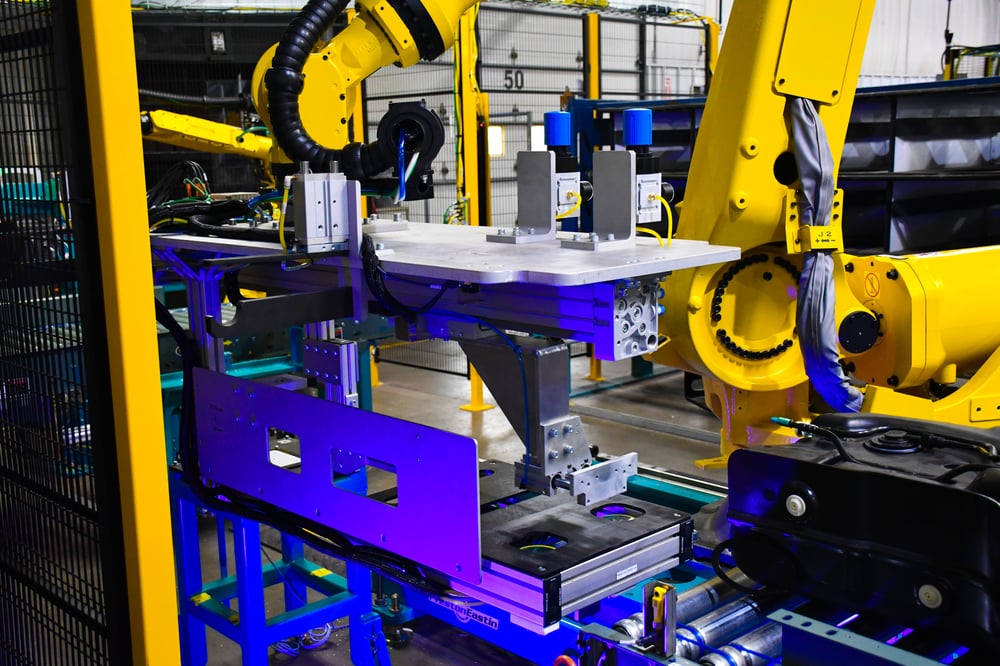
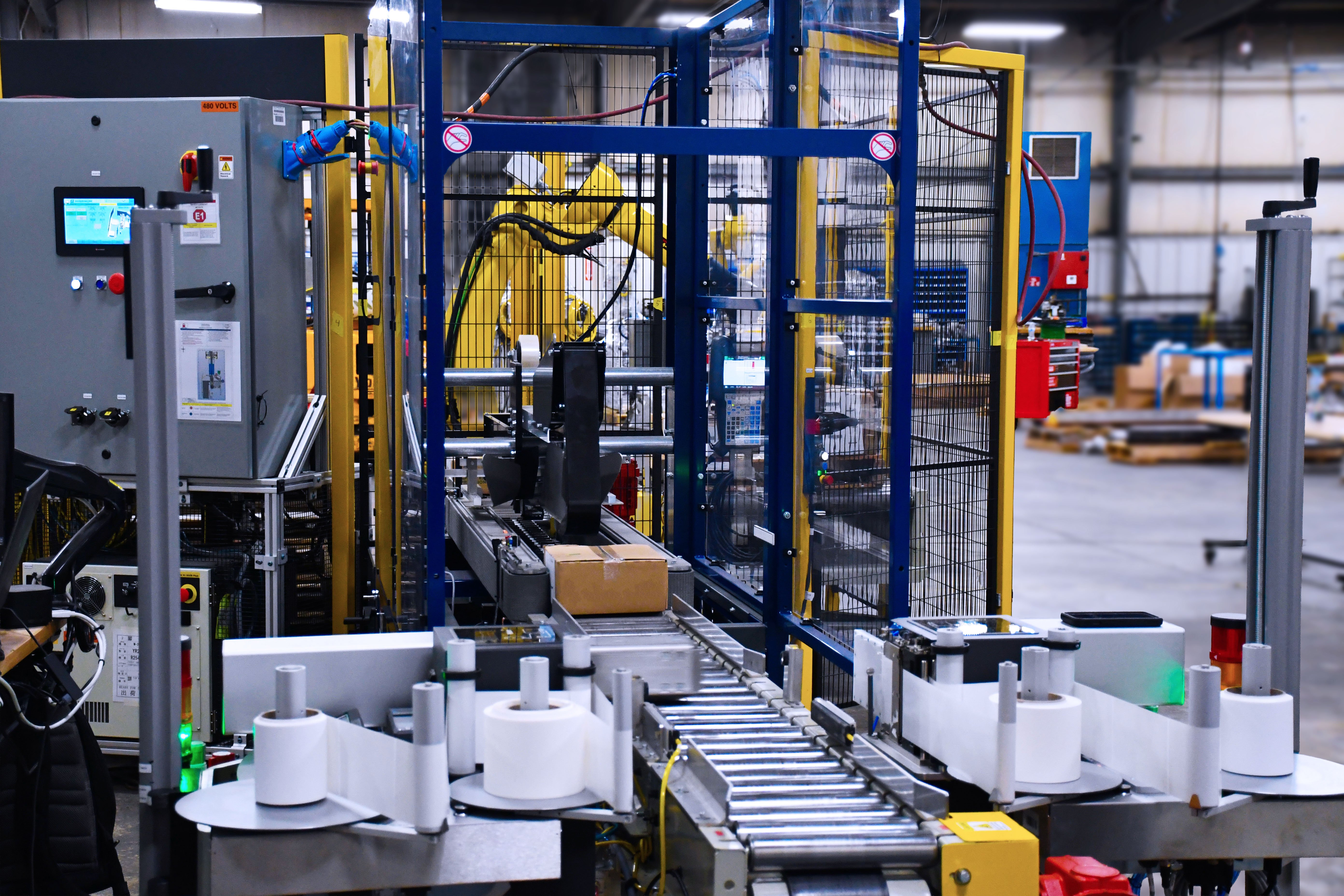
End-of-line automation covers everything after the product is made: case packing, labeling and marking, palletizing, and wrapping. It is the most common first project in general industry for a simple reason. The work is heavy, repetitive, and located at the point where a plant feels labor turnover most.
Robotic palletizing benefits show up quickly because the task is well defined. A robot builds the same pallet pattern at the same rate all shift, handles mixed case sizes with a tool change or a recipe change, and takes the lifting out of the job. Upstream, material handling automation moves parts between operations using robots, conveyor, and part tracking, with vision or force sensing added when parts arrive less consistently than anyone admits.
Machine tending is loading parts into a machine and taking them back out. It is the highest-volume application in the industry because nearly every plant has a machine with a person standing in front of it.
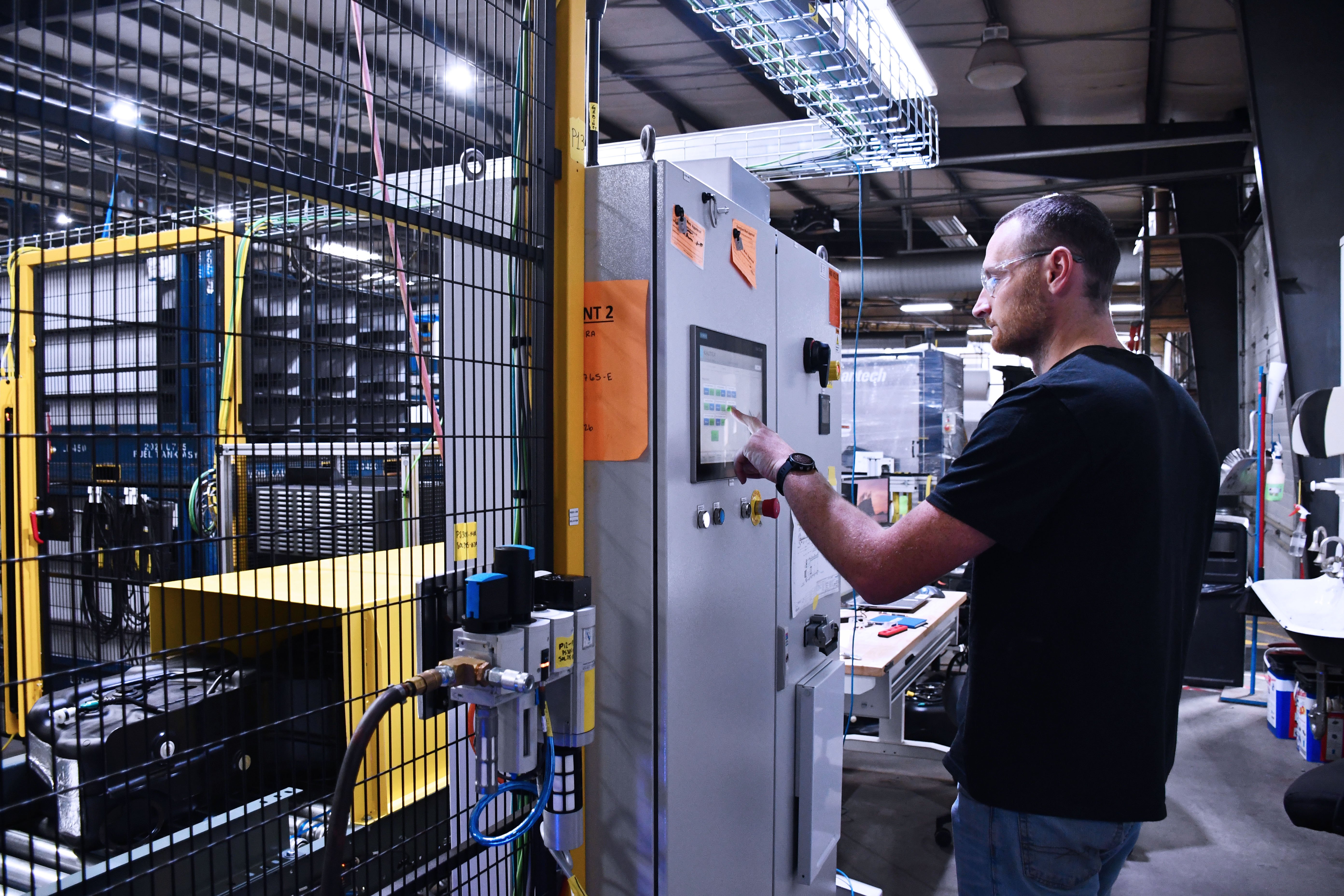
What changes is what that person does next. Tending work does not require the skill your machinists have, so a tended cell frees them for setup, inspection, problem solving, and running more than one machine. The candidacy questions are practical: run length, part presentation,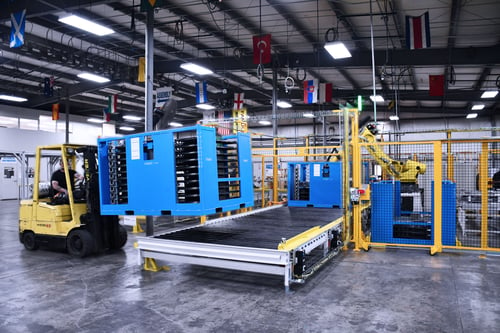 fixturing repeatability, and how much operator time actually comes back. We have been building machine tending cells for more than twenty years, and those four answers still decide whether a cell is worth building.
These are the applications where automation stops being about labor and starts being about consistency.
Automated assembly places components and verifies them, so a missing clip is caught at the station instead of at the customer. Dispensing runs adhesive or sealant along a programmed path, which controls bead quality and material use, from a straightforward dispense cell up to closed-loop fluid monitoring with vision checking the bead. Inspection and testing confirms correct assembly, presence, and orientation, either as a standalone test machine or built into a larger cell. For a fuller tour of these applications, see our industrial automation examples across modern manufacturing.
Automotive has automated for decades and gets the coverage. The growth is elsewhere, in plants running their first project rather than their fiftieth.
Medical device and life sciences plants automate for traceability and documented process control. Food and beverage automates packaging, palletizing, and inspection, where hygiene and turnover both bite. Commercial HVAC is expanding on the back of data center construction. Packaging,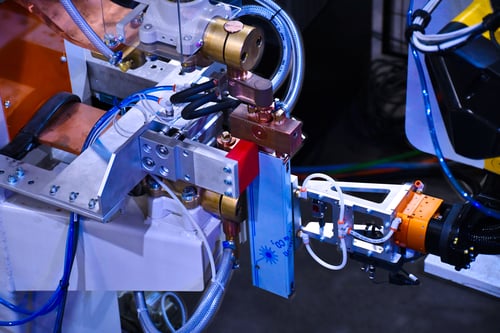 consumer goods, and general industrial fabrication all follow the same pattern: mid-sized operations with a task they can no longer staff and no automation experience in house.
The failure mode for a first project is scope, not technology. A cell that does one thing reliably teaches your team more than a line that does five things poorly.
If you are early in this and not sure what belongs in a first project, that is the conversation we would rather have than a quote. We come to your facility, walk your process with you, and tell you plainly what is worth automating and what is not. Get in touch with our team to set up a visit.
Automation is the broader term for running a process with reduced human intervention, including conveyor, controls, fixed equipment, and software. Robotics is one way to automate, using programmable machines that can be redeployed to different tasks. Most real systems combine both: a robot doing the flexible work inside a cell of conveyor, sensors, and controls.
Palletizing and machine tending are the two most common entry points. Both are well defined, repeat constantly, and require no judgment from the operator, which makes them straightforward to specify and easy to measure against a baseline. They also tend to return the most operator time per dollar spent.
Look for repeatability, consistent part presentation, adequate run length, and a measurable cost attached to doing it manually. Processes with high part variation, frequent changeovers, or heavy operator judgment are harder and usually belong in a later phase. A walkthrough with an integrator will separate the two faster than an internal debate will.
In practice, robots take over the specific tasks plants already struggle to staff, and the people move to setup, quality, maintenance, and running more equipment. The plants we work in are not trying to reduce headcount. They are trying to cover work they cannot hire for and keep the experienced people they have.
Cost and timeline depend on the application, cycle time requirement, part variation, and whether vision, inspection, or safety integration is needed. A single tended machine or a palletizing cell is a different project from an integrated multi-station line. The useful first step is a defined scope, since a scoped application can be quoted accurately and an open-ended wish list cannot.