Automation Solutions
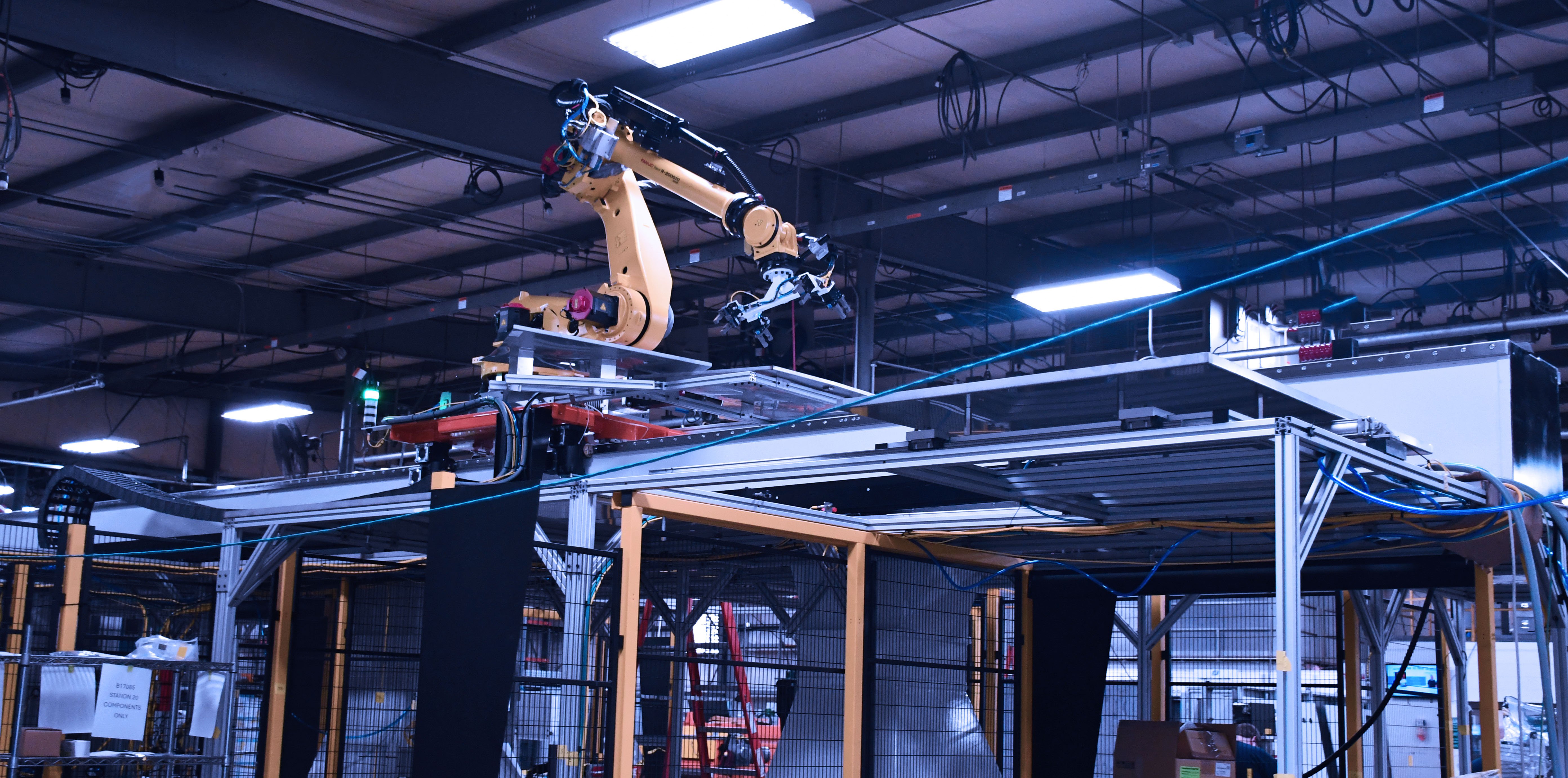

The most common industrial automation examples are robotic material handling, machine tending, assembly automation, palletizing, dispensing, inspection and testing, part feeding, autonomous mobile robots, marking and traceability, and process specific equipment such as tube end forming. Each one solves a different problem, which is why the useful question is not what exists but which one fits your bottleneck.
Most lists of industrial automation examples are organized by technology, which is backwards for anyone trying to make a decision. You do not have a robot problem. You have a station you cannot staff, a defect you cannot stop, or a move you keep paying people to make by hand. Below are the examples we build most often, sorted by the problem each one is actually good at solving.
Industrial automation is any system that performs a production task with machinery and controls instead of a person doing it by hand. That covers a very wide range, from a single robot loading one machine to a fully integrated line with conveyance, vision, and data collection running end to end.
The useful distinction is not manual versus automated. It is which task you are handing over. A plant can automate the moving, the making, the checking, or the recording, and those are four different projects with different costs and different payoffs. Our automation solutions overview covers how these pieces get combined into one system.
Ten examples we see and build most often. Read the middle column first, because that is the one that tells you whether it applies to you.
| Example | The problem it solves | Where it usually shows up |
|---|---|---|
| Robotic material handling | People spending their shift moving parts from one place to another | Between presses, ovens, washers, and packout |
| Machine tending | A skilled operator standing at a machine to load and unload it | CNC cells, presses, injection molding, grinders |
| Assembly automation | Repetitive joining, fastening, or inserting where consistency matters | Subassembly stations and final assembly lines |
| Robotic palletizing and packout | Heavy, repetitive stacking at the end of the line, and the injuries that come with it | Cases, bags, drums, molded parts, extrusions |
| Automated dispensing | Adhesive, sealant, or lubricant applied inconsistently by hand | Bonding, sealing, gasketing, potting |
| Inspection and testing | Defects that escape because a person cannot check every part | Vision inspection, leak test, functional test, gauging |
| Part feeding and presentation | Automation that stalls because parts do not arrive oriented | Upstream of nearly every robotic cell |
| Autonomous mobile robots and guided vehicles | Long, repeated material moves across a plant floor | Line side delivery, WIP transport, finished goods |
| Marking and traceability | No reliable record of what was built, when, and to what result | Regulated work, warranty exposure, recall risk |
| Process specific equipment | A forming or finishing operation a general purpose robot cannot do | Tube end forming, cutting, bending, decoating |
Start from the symptom rather than the technology. These are the connections we make most often when we walk a floor.
In practice they rarely appear alone. A single automated cell often includes four of the examples above at once. Parts are fed and oriented, a robot loads the machine, a vision system verifies the result, and a laser marks the part before it moves on. From the outside it looks like one machine. Inside, it is four decisions that had to agree with each other.
That is where integration work actually lives, and why the controls architecture matters more than the robot brand. The individual technologies are mature and widely available. Making them behave as one reliable system, on your parts, at your takt time, is the engineering. Our robotic automation page covers the robot types and applications we work with most.
Machine tending and end of line palletizing are the two most common first projects, for the same reasons. The parts are consistent, the motion is predictable, the work is difficult to staff, and the cell can be justified on its own without redesigning the rest of the line. Both also give your maintenance team real equipment to learn on before you attempt anything more integrated.
The hardest first project is usually final assembly with high product mix. It can absolutely be done, but it is a poor place to learn, because tooling flexibility and part presentation both get difficult at the same time.
Some operations cannot be handled by a general purpose robot with a gripper. Tube end forming is a clear example. Expanding, reducing, beading, or flaring a tube end takes purpose built tooling and a machine designed for that force and that geometry, not a robot holding a tool.
We design and build that equipment ourselves under Wauseon TubeTech, and we also integrate it into automated cells with robotic load and unload. That combination is the reason process equipment belongs on a list of automation examples at all. The forming machine solves the process, and the automation around it solves the labor and consistency. Our tube fabrication equipment page covers the machine line in detail.
You compare the cost of the problem to the cost of the fix, station by station, and you do it with real numbers rather than a category. The same technology can be an obvious yes at one station and a clear no at the next one, based on volume, part variation, and how reliably you can staff it today.
That is what an automation audit is for. We walk your process, look at the stations and the part flow, and tell you which of the examples above apply, which do not, and in what order we would do them. Sometimes the answer is that a process change gets you most of the way there for far less money.
Robotics is one component of industrial automation. A robot is a machine that moves a tool or a part. Industrial automation is the whole system, which can include robots but also conveyance, controls, sensors, vision, safety devices, and software. Plenty of automation involves no robot at all.
Material handling, by a wide margin. Moving parts between operations is the most repeated task in most plants, it requires no judgment, and it is the source of a large share of ergonomic injuries. That combination makes it the most frequently automated task across nearly every industry.
Yes, and the entry point is usually a single cell rather than a line. A one robot machine tending cell is a common first project for a shop with a few dozen employees. What matters is not company size but whether the work at that station is repetitive and the volume is steady.
It depends on the task. Process equipment such as tube end forming machines exists as a standard line with tooling built for your part. Integrated cells are usually custom, because your parts, your layout, and your takt time are specific to you. Most projects end up as standard equipment arranged in a custom configuration.
It varies with scope, and the honest answer is that concept and design take longer than people expect while installation takes less. The single biggest schedule risk is an unfrozen part design, because tooling cannot be finalized until the geometry is final.
Describe the symptom rather than the solution and we can usually point you at the right two or three options in a single conversation. Talk to our team and we will tell you which of these examples fit your plant and which ones we would leave alone.
Integrion Automation has been engineering and integrating automation since 1983, from Wauseon, Ohio and Greenville, South Carolina. From complexity to confidence.