
Skip to content

    Blank to Welded Part: Robotic Press Brake and Spot Weld Cell

    One robot squares, forms and spot welds sheet metal partition shoes in 13 sizes, from flat blank to finished part with no handling.

    SOLUTION BY IA_Favicon_Pos
    PUBLISHED

    Challenges

    01

    13 sizes across four product lines

    02

    Extra production volume formed and welded by hand

    03

    Repetitive handling at the press and welder

    04

    Operator exposure to forming and welding

    05

    No backup if the main line went down

    Results

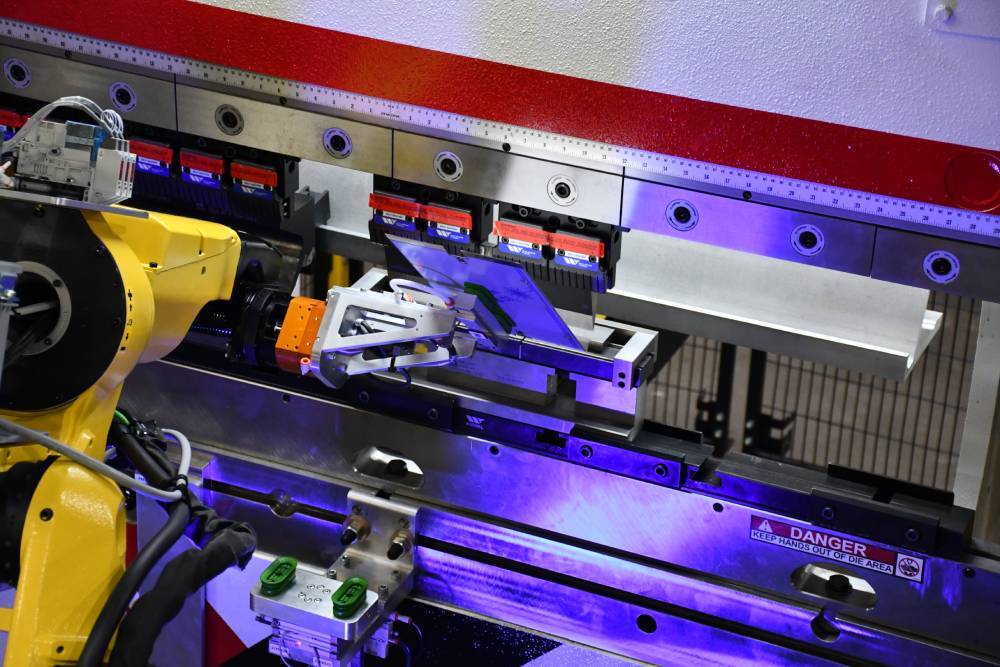
    FANUC robot presenting a sheet metal blank to a press brake for forming
    Ruler

    13 sizes from 3 to 24 inches in one cell

    Bot

    No operator handling once the cell starts

    Repeat

    Fast changeovers with an automatic tool changer

    layers

    Added capacity and a backup for the main line

    Box

    Common spare parts across both cells

    Loader

    Blank loading while the cell runs

    A manufacturer of bathroom stall partition hardware needed more capacity for its partition shoes. Its main automated line was already running, and the extra volume was being formed and welded by hand. That meant repetitive handling at the press brake and welder, operators working close to both, and no backup if the main line went down. The new cell had to handle the same high mix: 13 sizes from 3 to 24 inches across four product lines.

    We built a cell that takes flat blanks all the way to finished, welded parts. An operator loads blanks onto a servo turntable. Light curtain guarding lets loading happen while the cell runs, so the robot isn't waiting on anyone.

    A FANUC M-10iD/12 robot picks the top blank and sets it on a positioning table, which squares every part before it's formed. The robot then presents the blank to the press brake to form the shoe. From there, it tends a resistance spot welder, which welds one side, then the robot rotates the part 180° so the other side can be welded too. Finished parts leave the cell on a discharge conveyor.

    High mix comes down to tooling. An automatic tool changer switches between two end-of-arm tools, so changeovers between sizes and product lines stay quick and handling stays consistent from part to part.

    The design matches the cell already running in production. That adds capacity and gives the plant a backup for the main line. Both cells share common spare parts, which keeps maintenance simple, and operators already know how to run the equipment.

    Once the cell starts, there's no operator handling at the press or the welder. Work that used to be done by hand now runs in the cell, and skilled people are free for higher-value work.

    › Machine Tending

    Running a press brake by hand?

    We build cells that tend press brakes, welders and other machines, with tool changers and fixturing that handle high-mix work. Tell us about your parts.
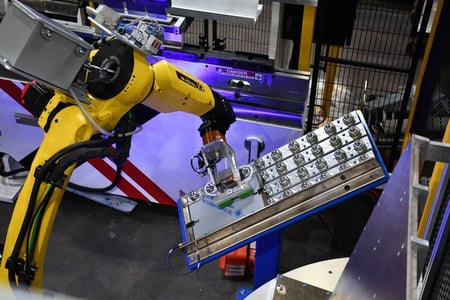
    FANUC M-10iD/12 robot placing a blank on the positioning table in front of the press brake
    › General Industrial

    Automation for high-mix fabricated parts

    From partition hardware to precision components, see how we automate forming, welding and handling for general industrial manufacturers.
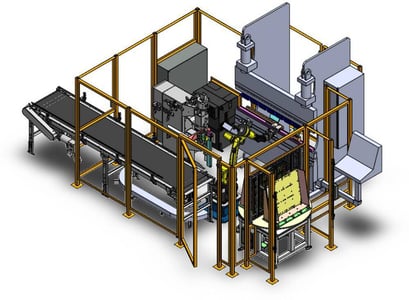
    Layout of the press brake and resistance welding cell with turntable, robot, welder and discharge conveyor