
Skip to content

    Plastic Gas Meters: SCARA Robot Assembly on a 12-Second Cycle

    A multi-station rotary dial cell uses SCARA robots to load the housing, mesh bowl-fed gears with torque sensing, press components and ultrasonically weld a complete plastic gas meter every 12 seconds.

    SOLUTION BY IA_Favicon_Pos
    PUBLISHED

    Challenges

    01

    Small plastic gears that have to mesh correctly every time

    02

    Many components fed and placed in one sequence

    03

    Press fits that need force and distance control

    04

    Housings that have to be sealed without damaging the part

    05

    High volume that called for a short, steady cycle

    Results

    Gas Meter  2
    Clock-1

    A complete gas meter assembled every 12 seconds

    Bot

    Gears meshed with torque sensing, not by feel

    Ruler

    Every press checked to force and distance

    Box

    Housings sealed by ultrasonic welding inside the cell

    repeat

    One operator loads housings to an accumulation conveyor

    Timer-outline

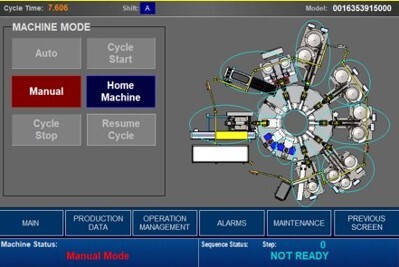
    Machine mode, cycle time and alarms visible on the HMI

    A gas meter manufacturer needed to assemble plastic gas meters at high volume. Each meter has a housing, a set of small plastic gears and several pressed components, and every one of those parts has to land in the right place. Gears that don’t mesh or a press fit that’s off means a meter that doesn’t measure correctly.

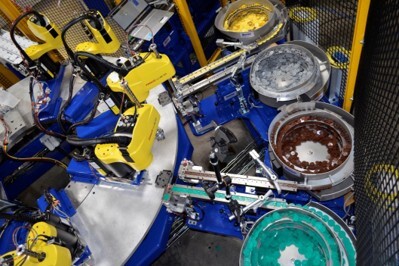
    Integrion built a multi-station rotary dial cell that handles the full assembly. Housings are pad printed off line, then an operator loads them onto an accumulation conveyor. From there, a SCARA robot picks each housing and places it on the rotary dial, which indexes the assembly from station to station.

    At the gear stations, plastic gears are bowl fed and loaded into the subassembly. SCARA robots mesh the gears using torque sensing, so the robot feels when the teeth engage instead of forcing them together. That keeps gears from binding or getting damaged during assembly.

    Next, plastic components are pressed in to a set force and distance, so every press fit is checked as it’s made. The last step seals the housing with ultrasonic welding, all inside the same cell.

    The result is a complete gas meter every 12 seconds. The operator’s job is loading housings, and the HMI shows machine mode, cycle time, production data and alarms at a glance.

    › Application

    Small parts assembly, done in one cell

    Feeding, gear meshing, pressing and welding can run on one rotary dial. Tell us what your assembly looks like and we’ll show you how it fits.
    Gas Meter 3
    › Industry

    Automation for general industrial manufacturers

    High-volume plastic and small parts assembly is core general industrial work. See how we build cells around it.

    Gas Meter 3