
Skip to content

    Plastic Fuel Tanks: Vision Inspection, Labeling and Robotic Rack Loading

    One cell reads each tank’s laser-etched code, inspects its components, applies and verifies the label, and loads finished tanks into racks with a FANUC robot.

    SOLUTION BY IA_Favicon_Pos
    PUBLISHED November 25, 2026

    Challenges

    01

    Four tank variants across two platforms on one line

    02

    Operators walking and handling tanks up to 40 pounds

    03

    Manual labeling and scanning open to operator error

    04

    Racks loaded by hand, one tank at a time

    05

    Traceability needed for every tank and every rack, across all shifts

    Results

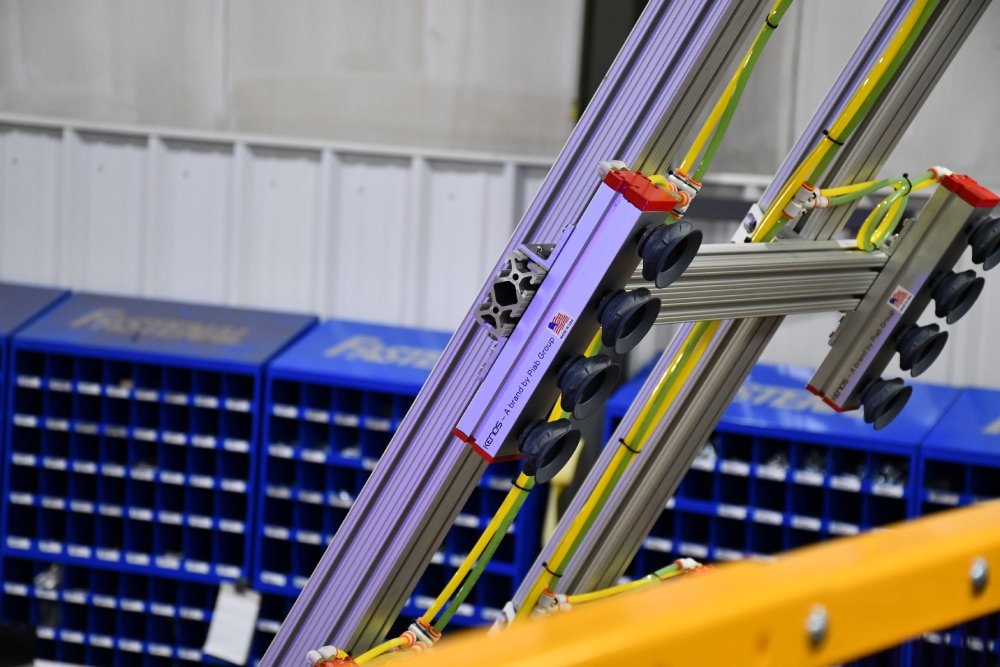
    Vacuum end-of-arm tool used to unload fiberglass door skins from the press
    Clock-1

    Four tank variants in one cell, 74 seconds or less per tank

    Bot

    No walk time and no manual tank handling at the rack

    scan

    Every label verified by vision before the tank moves on

    repeat

    Failed tanks diverted automatically for review

    Box

    Correct tank in the correct rack, traced across every shift

    shield-check

    Rack checks before every load to prevent crashes

    An automotive fuel system supplier was finishing plastic fuel tanks by hand. Each tank came off a roller table onto a slide table, where an operator applied a printed label, scanned it and then slid the tank into a rack. The tanks run 4 to 6 feet long and up to 40 pounds before wiring and components go on. That’s a lot of walking, a lot of lifting, and plenty of room for a missed scan or a tank in the wrong rack. The customer wanted that walk time, handling and error gone, without losing the option to run parts of the process manually.

    Integrion built one cell that handles the whole sequence. Forklift operators stage tanks at the cell, and they’re introduced onto a roller conveyor that carries each one from station to station.

    At the first station, the cell reads the barcode laser-etched into the tank to pull its serial number and history. A camera then checks that every component is present and assembled correctly for that specific tank. Pass, and the tank moves on. Fail, and it’s diverted to a reject conveyor. Next, the cell applies a label with the born-on date, QR code, serial number and customer part number, and vision verifies it before the tank goes any further.

    The last step is the rack. A FANUC robot with a custom end effector pushes each tank into its pocket and works the rack bar to lock it in place. Before loading, the system checks for a damaged pocket, a closed rack bar or anything in the bar’s path, so the robot never crashes into a bad rack. It also confirms the right tank is going into the right rack, and finished racks get their own verified label. A forklift operator swaps the full rack for an empty one.

    The cell runs four variants across long and short wheelbase platforms at 74 seconds or less per tank. Operators are out of the lift-and-carry work, every tank and rack is traceable across all shifts, and the layout leaves room for autonomous mobile robots down the road.

    › Application

    Inspect, label and pack out in one cell

    Vision checks, label verification and rack loading don’t need three separate stations. Tell us what your line runs and we’ll show you how it fits in one cell.
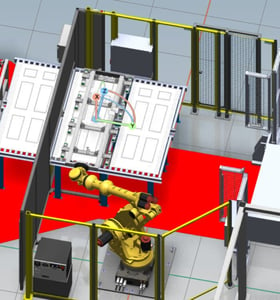
    3D layout of the robotic press tending cell with door skin accumulation conveyor
    › Industry

    Automation for transportation suppliers

    Large parts, multiple variants and full traceability are standard in transportation work. See how we build cells around them.

    3D layout of the robotic press tending cell with door skin accumulation conveyor