An automotive supplier needed to take manual handling out of its axle shaft line. Each shaft moves through a long run of operations: turning, drilling, spline rolling, washing, induction hardening, tempering and straightening. With seven part types sharing the line, that meant a lot of loading, unloading and moving parts between machines, and every shaft still had to be checked and tracked from start to finish.
We built a fully automated cell that processes, verifies and packs out the shafts, with seven robots moving parts through every step.
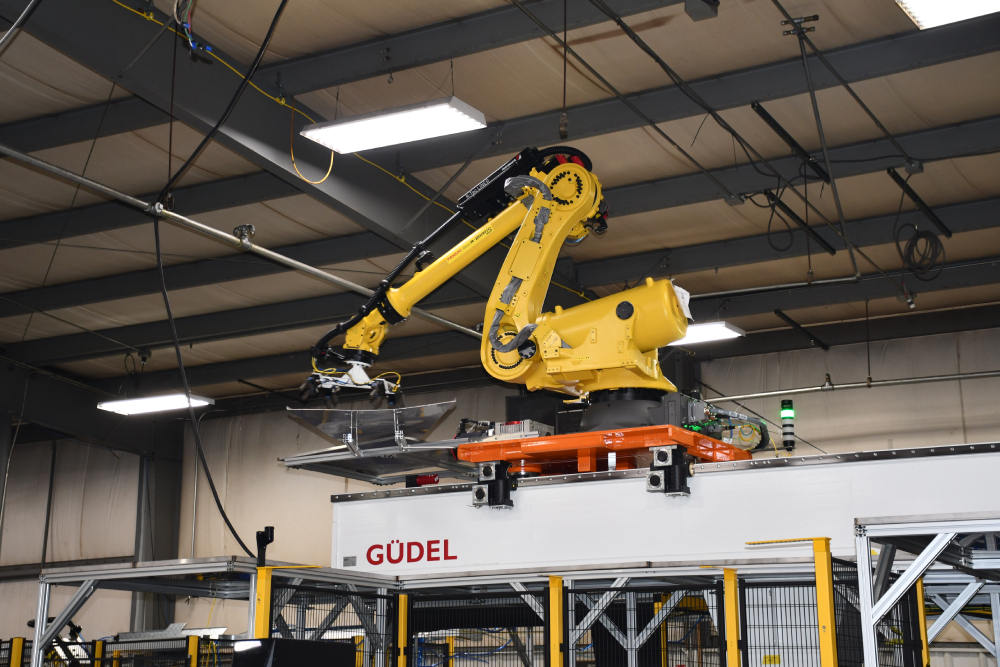
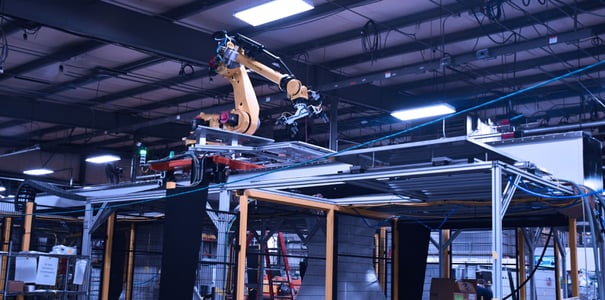
Operators load shafts onto a buffer conveyor. The first robot picks each shaft and sets it on a walking beam. A second robot, riding a Güdel robot transport unit, tends three lathes, a gauge check station and a Keyence laser marking station, then places the part on a transfer conveyor. From there, dedicated robots take over each stage: one tends two CNC drills and a spline roller, one runs the parts washer, one handles the induction center and tempering furnace, and one loads the shaft straightener. A final robot palletizes finished shafts into dunnage containers, ready to ship.
Traceability is built into the process. Each shaft gets a laser-printed barcode early in the line, and that code is read at every operation after it. The result is a record for every part as it moves through machining, heat treat and straightening, across all seven part types.
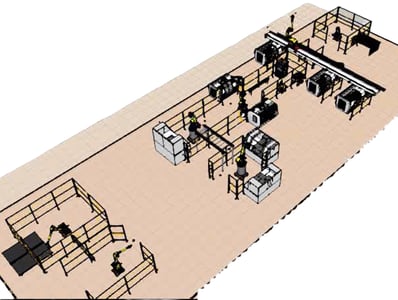
Before any equipment was built, we simulated the full process in ROBOGUIDE. That let us prove out robot paths, station sequencing and cycle time on screen, so the cell went together on the floor the way it was designed.
The finished cell runs at a 37-second cycle time. Manual work is limited to loading the buffer conveyor. Everything after that, from machine tending and gauge checks to part tracking and packout, runs automatically.