People of Integrion

The benefits of end of line automation are real, but they only get approved when they are attached to numbers you already track. Throughput, staffed hours, injury exposure, miscounts, shipping damage, and schedule attainment are all measurable at this station before and after, which is why it is the easiest automation project to justify.
Most articles on this subject list the same benefits and stop there. That does not help you get a project funded. This one is organized around where each benefit shows up in your own data, what to baseline before you start, and what erodes the gain after startup. We integrate the robotic cell at this stage and interface it to the packaging equipment you already run.
Every one of these is measurable with records your plant already keeps. That is the point. A benefit you cannot show in a report is a benefit finance will discount.
| Benefit | The number that shows it | Where the number comes from |
|---|---|---|
| Throughput no longer capped by the last station | Sustained cases or units per hour, compared shift to shift | Production reporting and line monitoring |
| Staffing pressure reduced | Hours staffed at the station, overtime hours, temporary labor hours | Scheduling and labor records |
| Injury exposure removed | Recordables, near misses, and restricted duty tied to the station | EHS log and workers compensation history |
| Quality escapes reduced | Miscounts, label errors, and customer complaints traced to packaging | Quality system and complaint records |
| Shipping damage reduced | Damage claims and returns per shipment | Shipping and customer service records |
| Output becomes predictable | Schedule attainment and on-time shipment percentage | Planning and logistics reporting |
| Floor space recovered | Square feet consumed by the station plus its staging area | Plant layout and a tape measure |
The most common reason a successful project cannot prove it succeeded is that nobody wrote down the starting point. Capture these before anything changes:
Two weeks of honest baseline data is worth more than a projection, because it is yours and nobody can argue with it.
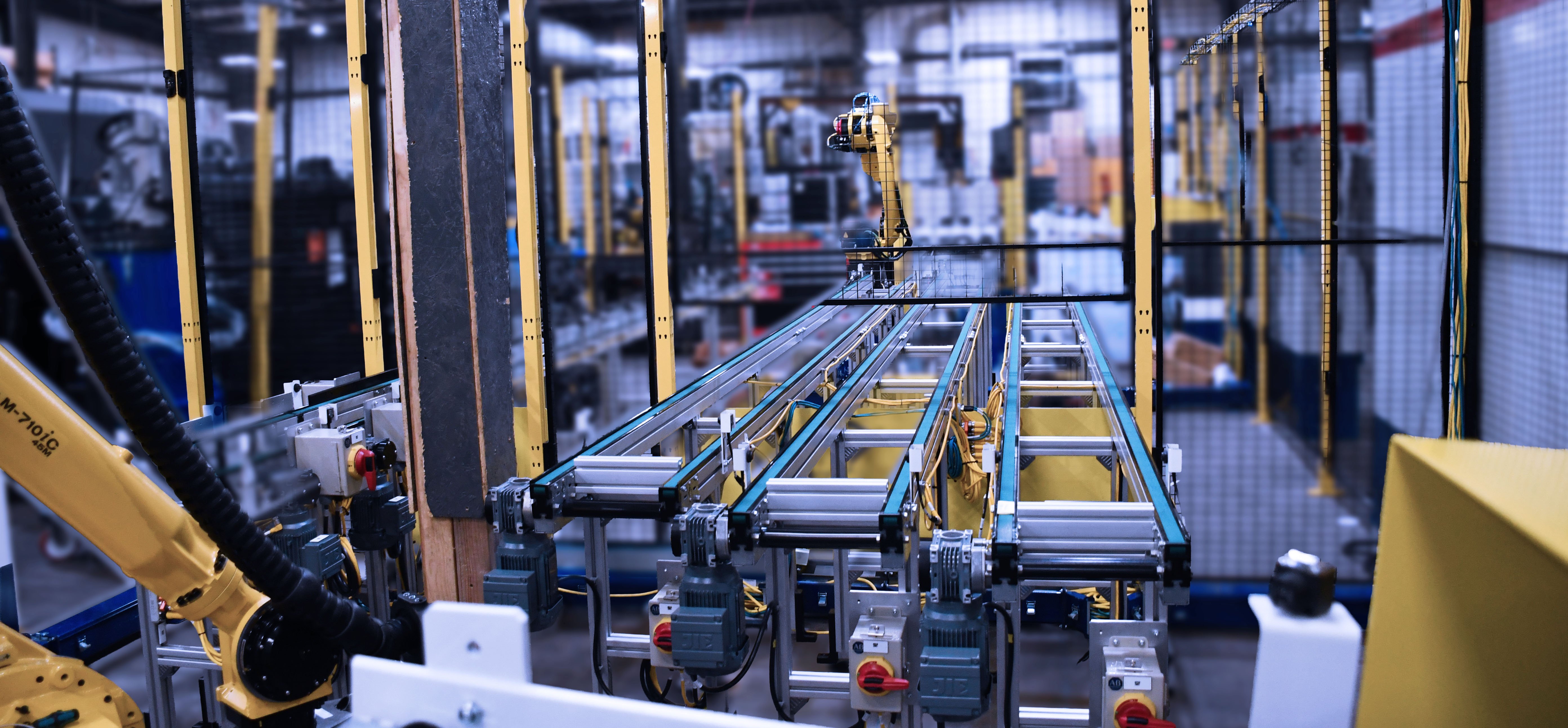
Palletizing is where the measurable gain is densest, which is why most plants start there. The lifting is the heaviest at this station, the pattern is fixed, the rate is already tracked, and the job is usually the hardest one in the building to keep filled.
A robotic cell holds the same rate through the end of third shift, builds the same pattern every time, and can serve more than one infeed from a single position. Pattern changes are program selections rather than mechanical changes, so a new pallet configuration does not mean new equipment. Where volume is moderate and case weights are lower, a collaborative palletizing cell is a legitimate entry point with a smaller footprint and simpler guarding, within its rate and payload limits. Above those limits an industrial robot is the right answer.
The same cell produces very different returns depending on what it is serving.
If your gain is mostly labor, be precise about which hours actually go away and which get redeployed. Projects lose credibility when the labor claim does not survive contact with the schedule.
Cells rarely underperform because the robot is slow. They underperform because of what surrounds them.
Compare the same numbers you baselined, and watch three in particular. Sustained rate across all three shifts, not the demonstrated maximum. Uptime with causes recorded, so faults get fixed instead of tolerated. And labor hours actually redeployed, which is what makes the next project easier to approve.
If you want to know what your end of line is costing today, that is a walkthrough, not a quote. We come to your facility, look at the station and the flow around it, and tell you plainly whether the numbers support a project. Get in touch with our team to set up a visit.
End of line automation covers the final stages of production, after the product is made and before it ships, including case packing, labeling, palletizing, and wrapping. In practice most plants automate the palletizing station first with a robotic cell, then extend to adjacent stages as the case is proven.
Baseline what you already track before anything changes: sustained rate by shift, hours staffed including overtime and temporary labor, downtime with causes, defect and complaint history at that stage, damage claims over a full year, and turnover at the station. Two weeks of real data beats a projection, and it makes the post-startup comparison unarguable.
It can be, where case weights and required rate sit inside collaborative limits. The advantages are a smaller footprint, simpler guarding, and a lower entry point for a first project. The constraints are payload and speed, so if your rate is high or your cases are heavy, an industrial robot is the better answer. The load and rate data decides it, not preference.
Yes, and most of these projects are retrofits. The engineering work is in the interfaces: conveyor elevations and transfers, signal exchange with the equipment already on your line, available floor space, and guarding inside a live plant. Installation sequencing to limit production downtime is part of the scope.
Usually infeed consistency and the handoffs at each end rather than the robot. Case quality, spacing, empty pallet supply, full pallet removal, and the cycle time of the equipment on either side all set the practical ceiling. A throughput model that accounts for those items is more useful than any single stated maximum rate.